

Building Bullet‑Proof Software: A Complete Guide to Application Security
Explore our Application Security guide that covers key ideas rising threats useful tools and clear steps to cut risk and keep your apps safe.
1. Introduction and Overview to AppSec
1.1 Definition and Importance of Application Security (AppSec)
Applications are crucial for business operations, from customer interactions to the storage and processing of critical data. Application Security includes processes, tools, and techniques designed to protect these applications from vulnerabilities and cyber threats throughout their lifecycle, from design, development, and implementation to maintenance and operations.
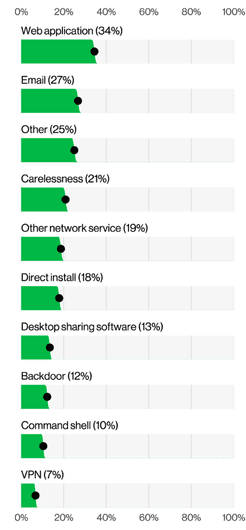
According to the Verizon’s 2025 Data Breach Investigations Report (DBIR), Web Application continues to be the perennial top action vector in breaches.
For organizations, the risk of neglecting effective AppSec practices can be severe: data breaches, financial losses, reputational damage, and regulatory penalties. With rising sophistication of cyberattacks, security must be integrated at every stage of Software Development Lifecycle(SDLC).
A key principle of AppSec is “shifting security left,” emphasizing early security integration in development. This proactive approach reduces vulnerabilities and the cost and complexity of remediating security issues. This model aligns with DevSecOps, where development, security, and operations teams collaborate continuously.
1.2 Evolution of AppSec and Current Trends
Previously, security testing was a final step in the SDLC, with penetration testing or security audits conducted before an application went live. However, agile development and continuous integration/continuous deployment (CI/CD) pipelines have made this approach inadequate, as the reactive nature of traditional testing leaves organizations vulnerable to new threats.
- Attacks on applications and software supply chains, along with the increased compliance and regulatory scrutiny, are imposing risk management requirements on application development teams.
- Application security continues to be seen as an impediment to application development. This perception will only get worse as security teams grapple with the use of AI coding assistants by development teams.
- Cloud-native application development and diverse deployment options (e.g., containers, microservices, serverless technologies) have increased the number and surface area of application assets that must be secured.
The rise in application-based cyberattacks has led to a fundamental shift in security strategies. Bolting security onto applications at the end of development proved ineffective. Instead, security evolved into an integral part of the DDI process. DevSecOps integrates security into every stage of development. Security automation tools like Static Application Security Testing (SAST) and Dynamic Application Security Testing (DAST) within CI/CD pipelines detect and address vulnerabilities in real time, enabling fast-paced development without sacrificing security.
Modern applications also increasingly rely on third-party APIs, open-source libraries, and microservices, expanding the potential attack surface. Therefore, supply chain security has become crucial, with new strategies to identify and mitigate risks. This has led to Software Composition Analysis (SCA) tools, which secure third-party components throughout an application’s lifecycle.
Zero Trust Architecture (ZTA) operates on the premise that no actor, system, or component, whether inside or outside the organization's network, should be trusted by default. Every request and user interaction must be continuously verified. This aligns with cloud-native applications, where decentralized services rely on APIs and microservices. Zero Trust frameworks emphasize on constant verification and encryption, reshaping how organizations safeguard their applications.
1.3 The Case for AppSec in the Modern Enterprise
As businesses embrace digital transformation, the attack surface is increasing, introducing new threats and vulnerabilities. The increasing sophistication of adversaries, from nation-state actors to cybercriminals, has made AppSec crucial. Applications are prime targets for threat actors due to direct access to sensitive data.
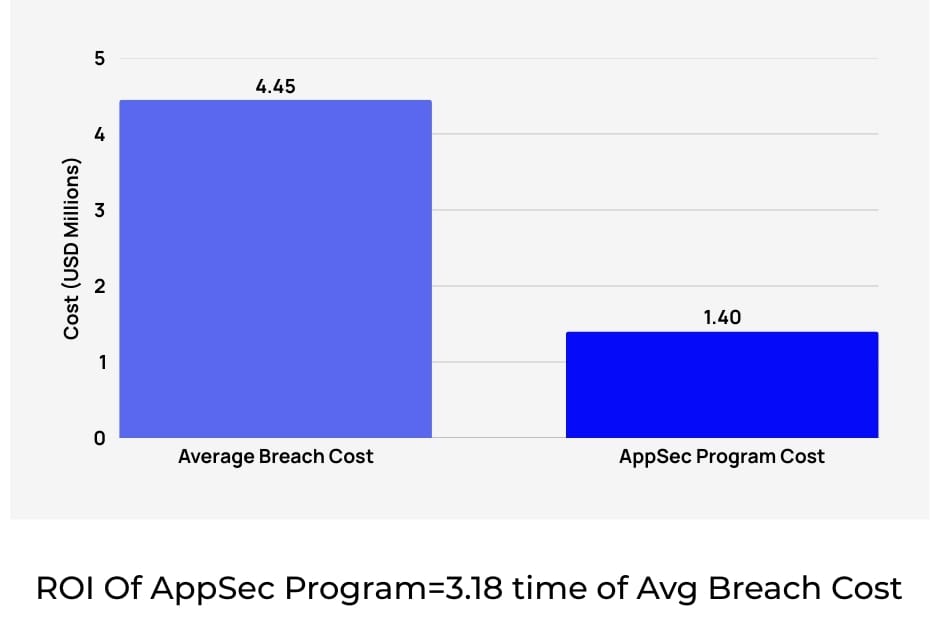
Consider the regulatory environment, which pressures organizations to adopt stringent security practices. Laws like General Data Protection Regulation (GDPR) and California Consumer Privacy Act (CCPA) hold organizations accountable for personal data breaches. Compliance with these regulations requires a strong AppSec program to avoid hefty fines and reputational harm.
AppSec is a core business requirement. Strong AppSec practices ensure compliance, provide a competitive advantage by building trust with customers, partners, and regulators.
Secure applications enhance confidence in digital services and allow organizations to operate with reduced risk, greater agility, and improved resilience against attacks.
As applications become central to business operations, cybersecurity leaders must prioritize security throughout the application lifecycle. This ensures applications remain secure amid continuous change and evolving threats. In the following sections, we will explore key principles, emerging threats, and best practices for building a resilient AppSec program.
2. Key Concepts and Principles of AppSec
2.1 Confidentiality, Integrity, and Availability (CIA Triad)
The CIA Triad, Confidentiality, Integrity, and Availability, forms the core of any information security strategy, including AppSec. These three principles ensure the protection of applications and sensitive data:
- Confidentiality: This ensures that sensitive data is accessible only to authorized users through encryption, access controls, and identity management. Techniques like AES-256 encryption, multi-factor authentication (MFA), and role-based access controls (RBAC) are used to protect data at rest and in transit. DHS CISA's Secure By Design emphasizes default security configurations that prioritize confidentiality. Applications should be designed to enforce encryption and access control policies from the start, ensuring sensitive data is protected from unauthorized access.
Reference: Best practices on encryption are detailed in NIST SP 800-175
- Integrity: Integrity ensures data accuracy and prevents alteration during storage or transit. Cryptographic hashing (e.g., SHA-256) and digital signatures validate data integrity, while regular monitoring, automated logging, and secure development practices detect unauthorized changes. Using NIST's Secure Software Development Framework (SSDF), integrity is maintained through secure coding practices, version control, and testing strategies, identifying issues early in the SDLC.
Reference: NIST guidelines on data integrity can be found in NIST SP 1800-25
- Availability: Ensuring applications are operational when needed is crucial. Organizations use redundant systems, load balancers, and scalable cloud infrastructure to guarantee availability. Distributed Denial of Service (DDoS) protection and incident response protocols are essential to protecting it. CISA's Secure By Default principle reinforces the idea that availability should be built into systems from the start, including pre-configured performance thresholds, backup strategies, and incident response plans.
Reference: For availability best practices, refer to NIST SP 800-34 Rev.1
These principles form the foundation of secure applications, ensuring data remains protected, accurate, and accessible.
2.2 Security by Design and Default
Secure by Design integrates security measures into the application architecture from the start of the SDLC. This proactive approach prevents vulnerabilities before they are introduced and creates resilient applications.
DHS CISA’s Secure By Design emphasizes integrating security into software from the outset, rather than addressing vulnerabilities later. This requires continuous collaboration between developers, security teams, and system architects to implement secure practices throughout development.
Key elements of Secure by Design include:
- Threat Modeling: During early design, identify potential attack vectors and assess risks. This involves identifying critical assets, analyzing attack methods, and developing mitigation strategies using frameworks like STRIDE and DREAD.
Reference: Learn more about threat modeling in OWASP Threat Modeling
- Secure Coding Standards: Adhering to secure coding standards helps developers avoid vulnerabilities like SQL injection or cross-site scripting (XSS). The NIST SSDF promotes coding practices to avoid common security flaws, and tools like SAST automate flaw detection during development.
Reference: OWASP Secure Coding Practices
- Automated Security Testing: Integrating SAST and DAST tools into CI/CD pipelines enables early detection and fixing of vulnerabilities before they reach production, aligning with both DHS’s Secure By Default and NIST SSDF for continuous testing during development.
Reference: For more on security testing, refer to NIST SP 800-53
Security by Default complements Security by Design by ensuring that applications are securely configured from the start, enforcing HTTPS, disabling unnecessary services, and enabling strong authentication. This reduces configuration errors, a common source of vulnerabilities.
2.3 Least Privilege and Defense in Depth
Least Privilege limits access rights to the minimum. This reduces potential damage and restricts attackers’ ability to escalate privileges or move laterally.
- RBAC: It restricts user permissions based on their roles. For example, a developer may access development but not production environments.
- API Keys and OAuth Tokens: Using restricted API tokens and OAuth grants limits access to external services. Tokens should expire quickly, and permissions should be carefully scoped.
Defense in Depth uses multiple lines of defense to protect against attacks, ensuring that if one fails, others remain effective.
- Firewalls: Network and application firewalls filter out malicious traffic before it reaches the application.
- Encryption: Encrypting data both at rest and in transit adds a layer of protection. Even if attackers access it, they cannot decipher it without decryption keys.
- MFA: It adds an additional security layer, preventing unauthorized access even if user credentials are compromised by requiring additional verification.
- Intrusion Detection and Prevention Systems (IDPS): IDPS tools monitor network traffic and system behavior to detect signs of an attack, triggering alerts when suspicious activity is detected for quick response.
CISA’s Secure by Design reinforces Defense in Depth by promoting multi-layered security, ensuring controls at every application level. NIST SSDF emphasizes layered security, applying best practices across SDLC to sustain resilience against diverse threats.
3. Emerging Threats and Trends in AppSec
3.1 OWASP Top Ten Vulnerabilities
The Open Worldwide Application Security Project (OWASP) is a globally recognized organization most famously known for their OWASP Top 10. Understanding these vulnerabilities helps cybersecurity professionals proactively defend against common threats.
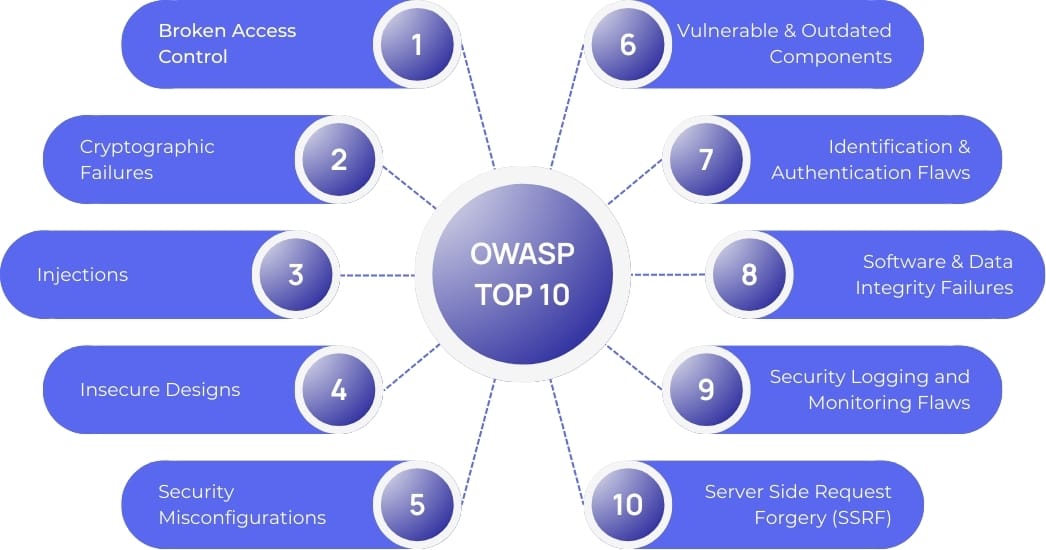
The latest OWASP Top 10 list includes:
- Broken Access Control: Occurs when authorization mechanisms fail, allowing attackers to access unauthorized data or functions. Example: Manipulating session tokens to gain admin privileges.
- Cryptographic Failures: Weak or improper encryption can expose sensitive data due to outdated encryption algorithms or lack of encryption.
- Injection Attacks: Occur when an application allows untrusted input to be sent to an interpreter, leading to arbitrary code execution.
- Insecure Design: This vulnerability occurs due to poor security practices during the design phase, where critical security features are overlooked.
- Security Misconfiguration: Occurs when systems use insecure settings, such as default passwords, unpatched systems, or exposed services.
- Outdated Components: Using outdated libraries or open-source components with known vulnerabilities can expose applications to exploitation.
- Authentication Failures: Poor session management or password policies can allow unauthorized access.
- Software and Data Integrity Failures: Compromised updates, libraries, or pipelines can introduce malicious code.
- Security Logging and Monitoring Failures: Inadequate logging and monitoring make it difficult to detect and respond to breaches in a timely manner.
- Server-Side Request Forgery (SSRF): Occurs when an attacker manipulates server-side requests to access internal systems or services.
3.2 Emerging Threats and Trends in AppSec
With the rapid pace of technological advancements, new threats and attack surfaces are emerging that organizations must be aware of and mitigate effectively.
Emerging Cybersecurity Threats| Threat Category | Description | Emerging Threat |
|---|---|---|
| API Security | With the rise of microservices, securing APIs is crucial. Common vulnerabilities include improper authentication, excessive data exposure, and lack of rate limiting. | APIs often expose sensitive data, increasing the risk of breaches when access controls are weak. |
| Supply Chain Attacks | Supply chain attacks target third-party libraries, components, or services used within an application. Compromised dependencies allow attackers to gain access to critical systems. | With the increased use of open-source software and third-party APIs, attackers are targeting less-secure components to infiltrate organizations. |
| Container Security Vulnerabilities | Containers, like those in Docker and Kubernetes, introduce security risks if misconfigured, leading to privilege escalation, unauthorized access, or data breaches. | Insecure container images, weak access controls, and improper isolation of containers can cause vulnerabilities and system access by attackers. |
| Ransomware Targeting Applications | Ransomware attacks are increasingly targeting applications by exploiting weak access controls or vulnerabilities to gain entry and encrypt critical data and demand ransom. | Attackers may exploit application vulnerabilities to deploy ransomware, disrupting business operations and causing financial damage. |
| Cloud-Native Security Challenges | Cloud applications face risks like misconfigured storage, insufficient identity and access management (IAM), and insecure API gateways. | Misconfigurations and weak IAM policies can expose cloud applications to external threats, leading to unauthorized data access. |
| Zero-Day Exploits | Zero-day vulnerabilities are unknown security flaws in software, meaning no patch is available. These vulnerabilities provide attackers with a window of opportunity to exploit systems before a fix can be deployed. | As software becomes more complex, the likelihood of undiscovered vulnerabilities grows, increasing the potential for zero-day exploits. |
4. Best Practices in AppSec
4.1 Secure Coding Practices
At the core of AppSec is secure coding, where developers embed security into the SDLC to prevent vulnerabilities in the codebase. Secure coding principles are not merely best practices but essential strategies to defend against cyber threats.
- Use Parameterized Queries: To mitigate SQL injection attacks, use parameterized queries, to ensure user inputs are treated as data, not executable code.
- Avoid Hardcoding Sensitive Information: Instead of hardcoding API keys, passwords, or cryptographic secrets in source code, store them in environment variables or secure vaults, like AWS Secrets Manager or HashiCorp Vault.
- Input Validation and Output Encoding: Validate user inputs to ensure they conform to expected formats and ranges, preventing SQL or XSS injection attacks. Sanitize and encode outputs to avoid rendering untrusted data as executable code.
- Secure Error Handling: Error messages should be generic and not reveal sensitive system details to users. This prevents attackers from gaining useful information. Maintain detailed error logs for internal debugging and incident response.
Reference: For thorough input validation and encoding practices, refer to OWASP Secure Coding Guidelines.
4.2 Authentication and Authorization
Implementing strong authentication and authorization ensures only authorized users and services access an application’s resources.
- MFA: It adds an additional layer of security by requiring two or more verification methods, reducing the risk of unauthorized access, especially where passwords have been compromised.
Tip: Use token-based MFA (e.g., OTPs via email/SMS or app-based tokens like Google Authenticator) for all privileged accounts and critical applications.
- OAuth and Token-Based Authentication: OAuth 2.0 uses secure, stateless token-based authentication for web applications. By generating secure tokens (e.g., JSON Web Tokens, or JWT), applications enhance scalability and security.
Best Practice: Use short-lived encrypted tokens and refresh tokens for secure session renewal without exposing user credentials.
Reference: Learn more about secure token management in NIST SP 800-63B
- RBAC and Attribute-Based Access Control (ABAC): Role Based Access Control (RBAC) limits resource access based on user roles, ensuring minimal privileges. ABAC enhances this by considering attributes like time, location, and device for more precise control.
Example: A finance team member might have access to reports but not to administrative functions. ABAC could limit access based on the user’s location, like allowing access only within the corporate network.
4.3 Security Testing and Assessment
Integrating security testing into the development pipeline is crucial for identifying and fixing vulnerabilities early, especially in agile environments using Continuous Integration and Continuous Deployment (CI/CD) practices.
- Static Application Security Testing (SAST): SAST tools scan the source code for security vulnerabilities without executing the application, detecting vulnerabilities like SQL injection, buffer overflows, and improper use of cryptographic functions early in the SDLC. This reduces remediation costs.
Best Practice: Run SAST tools on every code commit and before merging code into production. Automate real-time feedback for developers.
Reference: Learn more about integrating SAST into development workflows via OWASP Code Review Guide
- Dynamic Application Security Testing (DAST): DAST tests the application in its running state, simulating attacks to find vulnerabilities like XSS or authentication flaws.
Best Practice: Use DAST tools in pre-production to find vulnerabilities not evident in static code analysis, ensuring security in real-world conditions.
- Interactive Application Security Testing (IAST): IAST tools combine SAST and DAST elements to provide real-time feedback on vulnerabilities during runtime, detecting issues like insecure data handling or improper session management.
Best Practice: Deploy IAST tools during both development and testing phases to get immediate feedback on potential vulnerabilities in the running environment.
- Software Composition Analysis (SCA): SCA tools scan third-party libraries for vulnerabilities, alerting developers to outdated or insecure components.
Best Practice: Automate SCA scans in your CI/CD pipeline to ensure third-party components are always up-to-date and free from vulnerabilities.
- Penetration Testing: Regular manual penetration testing simulates real-world attacks and uncovers complex vulnerabilities that automated tools may miss.
Best Practice: Schedule penetration testing annually or after major code changes. Combine the results with automated testing for a complete security posture.
- Secure Code Review: Regular code reviews should include security checks to ensure best practices are followed and common vulnerabilities are avoided. Conduct peer reviews to address security concerns in every review cycle.
Reference: For thorough strategies, refer to OWASP Secure Code Review Guide.
4.4 Areas Covered in Security Testing
At a minimum, Application Security testing should cover the following areas to ensure complete protection:
- Source Code: SAST scans should detect coding issues like SQL injection and XSS.
- Third-Party Components: SCA tools ensure third-party libraries are free from known vulnerabilities.
- Authentication and Authorization: Test login systems, session management, and RBAC for strong access control.
- API Security: Perform extensive tests on APIs, ensuring that all API requests are authenticated and authorized.
- Data Handling: Validate input and output to prevent injection attacks and ensure proper encoding.
- Runtime Behavior: Use DAST and IAST to detect vulnerabilities when the application is running.
- Compliance: Ensure the application meets regulatory standards like PCI-DSS and GDPR.
5. AppSec and Zero Trust
5.1 How AppSec Enables Zero Trust
The Zero Trust security model ensures no user, system, or device should be automatically trusted. Every access request must be verified and continuously validated before access is granted. AppSec is key to implementing Zero Trust in modern enterprises.
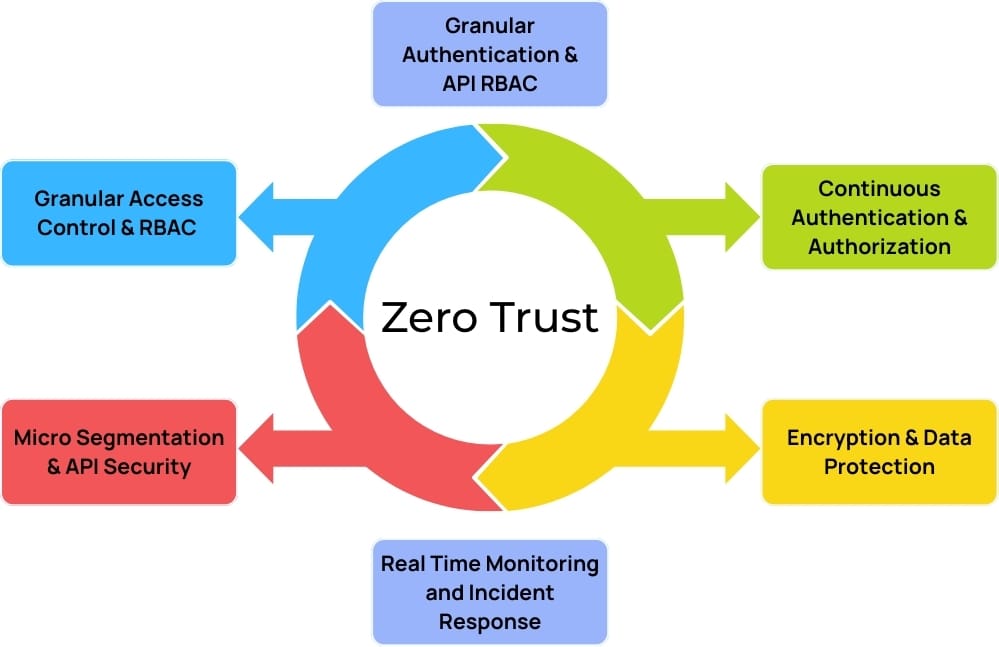
Key AppSec Principles Supporting Zero Trust:
- Granular Access Controls and RBAC: Zero Trust requires restricted access based on least privileges. RBAC ensures users only access necessary resources. Advanced models like ABAC restrict access based on location, device type, or time of access.
Best Practice: Implement fine-grained access controls at the application level, ensuring that users and services are only granted minimal privileges. - Continuous Authentication and Authorization: In a ZTA, authentication and authorization are ongoing processes. MFA, token-based authentication (e.g., OAuth 2.0), and adaptive mechanisms ensure security after initial login. Applications should require re-authentication for sensitive actions or revalidate access tokens.
Best Practice: Enforce session expiration policies and regularly refresh access tokens to maintain continuous authentication. - Micro-segmentation and API Security: Zero Trust emphasizes breaking down applications into smaller segments, each with its own access control policies. In environments where APIs are widely used, secure API management is critical to prevent unauthorized access.
Best Practice: Use API gateways with authentication, rate limiting, and monitoring for secure communication between microservices. - Encryption and Data Protection: Zero Trust requires encryption at rest and in transit. AppSec enforces standards like TLS 1.3 for data exchanges and secure storage for sensitive data.
Best Practice: Use end-to-end encryption to protect sensitive data and implement proper key management practices. - Real-Time Monitoring and Incident Response: Zero Trust relies on continuous monitoring to detect threats. Integrating SIEM systems provides real-time visibility and alerts for unauthorized access attempts, helping rapid incidence response.
Best Practice: Use logging and monitoring tools to track suspicious activity and enforce real-time threat detection.
AppSec is key to implementing a ZTA. By enforcing continuous authentication, granular access controls, secure API management, and complete monitoring, organizations can protect their applications and sensitive data from threats. AppSec provides the necessary tools to implement and maintain Zero Trust at the application level.
6. AppSec and Cybersecurity Supply Chain Risk Management (C-SCRM)
6.1 How AppSec Enables C-SCRM
The increasing reliance on third-party components, open-source libraries, and external services has expanded the attack surface of applications. C-SCRM aims to mitigate these risks. AppSec ensures third-party components are secured, reducing the supply chain attack risks. Practices aligned with NIST 800-161 and tools like the Software Bill of Materials (SBOM) provide visibility and control over third-party dependencies.
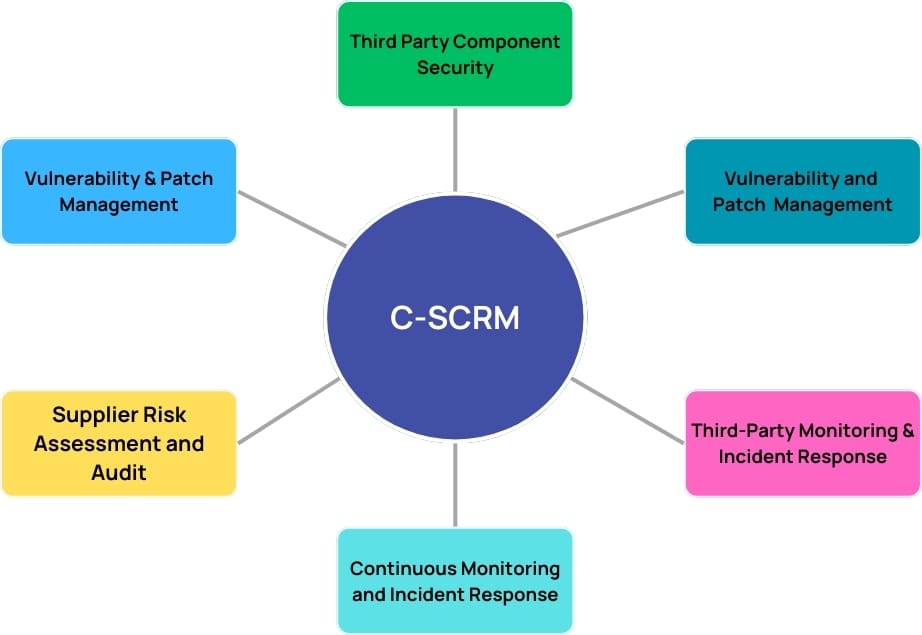
Key AppSec Principles Supporting C-SCRM:
- Third-Party Component Security: Applications heavily rely on third-party components and open-source libraries, which can introduce vulnerabilities. NIST 800-161 recommends maintaining visibility into the security of external suppliers and their components.
Mitigation: Use SCA tools to monitor third-party libraries for vulnerabilities. Keep these libraries updated with security patches. Create and manage a SBOM to track all third-party dependencies and ensure supply chain transparency.
Best Practice: Adopt SBOM management practices to document the origin, version, and security status of each component, as advised in NIST 800-161 and Executive Order 14028.
Reference: Learn about SBOMs and their role in supply chain security in NIST SBOM Guidance.
- Vulnerability and Patch Management: Vulnerabilities within third-party components are crucial. Effective practices aligned with NIST 800-161 include regular scanning, patching, and monitoring of software components.
Mitigation: Integrate vulnerability scanning tools into your CI/CD pipeline to identify issues with third-party components early. The SBOM helps pinpoint which components need updates, while NIST 800-161 on prioritizing and applying patches promptly.
Best Practice: Automate patch management using SBOM and SCA tools to ensure third-party libraries are regularly updated, mitigating emerging risks.
- Supplier Risk Assessment and Auditing: Organizations must assess the security practices of third-party suppliers to ensure the safety of their components. NIST 800-161 provides guidance on evaluating the security posture of suppliers and potential risks they introduce.
Mitigation: Regularly audit third-party suppliers to ensure they follow security best practices, such as secure development and vulnerability management.
Best Practice: Require suppliers to provide SBOMs and security reports, enabling risk assessment of third-party components in line with NIST 800-161.
- Continuous Monitoring and Incident Response: Continuous monitoring maintains visibility into the security of third-party components after deployment. Real-time tools alert for vulnerabilities or anomalies.
Mitigation: Use SIEM tools to monitor external components and services. Configure them to cross-reference SBOM vulnerabilities and alert for unexpected behavior.
Best Practice: Align your monitoring practices with NIST 800-161 by continuously monitoring all third-party components and having a response plan for supply chain incidents.
By using NIST 800-161 guidance and tools like SBOMs and SCA, organizations can better manage supply chain risks in AppSec. Continuous monitoring, patch management, and regular supplier assessments are critical for securing third-party components and mitigating supply chain attacks.
7. AppSec vs. Other Security Testing Approaches
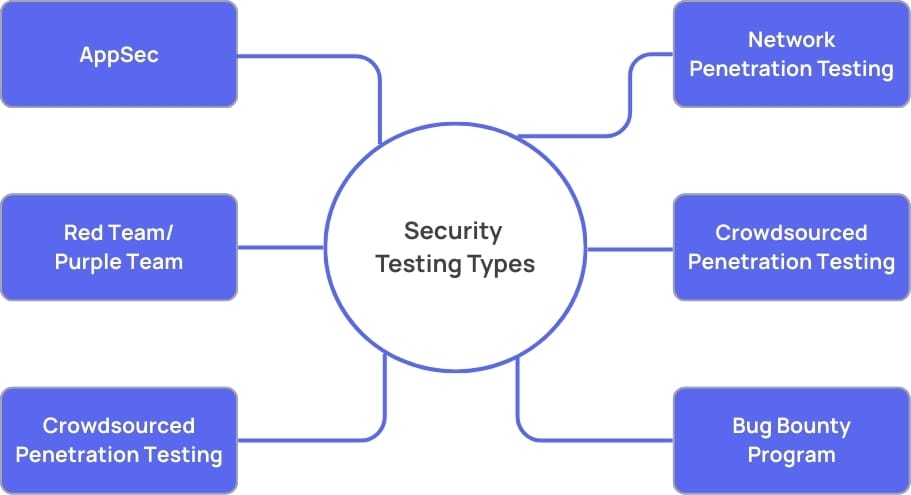
7.1 AppSec vs. Network Penetration Testing
AppSec focuses on securing software applications against vulnerabilities like SQL injection, XSS, authentication flaws, and insecure data handling. It involves secure coding practices, vulnerability scanning, threat modeling, and automated security testing (e.g., SAST, DAST) throughout the SDLC.
Network Penetration Testing (pentesting) evaluates the security of an organization’s network by exploiting vulnerabilities in devices (e.g., firewalls, routers, switches) and services (e.g., FTP, SSH) to gain unauthorized access or disrupt operations. It simulates real-world attacks to identify weaknesses in configurations, patch management, or defenses.
- Key Difference: AppSec secures application code and architecture, while network pentesting targets network configurations and devices.
Example: AppSec focuses on flaws in API endpoints or insecure authentication, while network pentesting targets open ports or vulnerable network services that could allow access to backend systems.
7.2 Red Team/Purple Team Exercises vs. AppSec
Red Team exercises are designed to simulate a full-scale attack on an organization’s security defenses, often with no prior warning to the defenders (Blue Team). The Red Team behaves like adversaries, employing tactics such as social engineering, lateral movement, and privilege escalation to compromise the organization. The goal of Red Team exercises is to identify gaps in the organization’s defense mechanisms, including weaknesses in both network security and AppSec.
Purple Team exercises, by contrast, involve collaboration between Red and Blue Teams. The focus is on improving the organization’s defensive capabilities by creating a feedback loop between attackers (Red Team) and defenders (Blue Team), ensuring that lessons learned are applied in real-time to strengthen defenses.
In AppSec, the focus is narrower, targeting vulnerabilities specific to applications, such as insecure coding practices, API vulnerabilities, and input validation issues. It involves testing the security of software as it is being developed or after it has been deployed.
- Key Difference: Red Team and Purple Team exercises cover a broader scope, simulating real-world adversary tactics across all layers (network, application, physical), while AppSec focuses exclusively on protecting the application layer through continuous testing and secure development practices.
Example: A Red Team might simulate a phishing attack to steal user credentials and then exploit an application’s authentication flaws to gain unauthorized access. AppSec, in this case, would focus specifically on fixing those flaws, ensuring that vulnerabilities such as weak password storage, improper session management, or lack of MFA are addressed.
7.3 Crowdsourced Penetration Testing vs. AppSec
Crowdsourced Penetration Testing involves drawing on a community of ethical hackers to find vulnerabilities in an organization’s systems. Organizations often offer rewards for valid vulnerabilities found (similar to bug bounty programs) and benefit from the diverse skill sets and perspectives of multiple testers. Crowdsourced pen tests can uncover a wide variety of issues, including those in applications, network infrastructure, and APIs.
AppSec, on the other hand, is typically more structured and internal, focusing on secure coding practices, automated vulnerability scanning, and regular security assessments as part of the SDLC. It is a proactive approach that aims to identify and fix vulnerabilities before the application goes live.
Key Difference: Crowdsourced penetration testing occurs after an application has been deployed, using external testers to find vulnerabilities that internal teams may have missed. In contrast, AppSec emphasizes securing the software throughout its development, including design, code review, and pre-deployment testing.
Example: In crowdsourced pentesting, a group of ethical hackers might test a live web application for flaws like SQL injection or broken access controls. AppSec, however, would work to ensure those vulnerabilities are addressed during the development process, ideally preventing them from ever making it into production.
7.4 Bug Bounty Programs vs. AppSec
Bug Bounty Programs incentivize external security researchers (often referred to as "bounty hunters") to discover and report vulnerabilities in an organization’s applications in exchange for financial rewards. These programs allow organizations to benefit from the collective intelligence of a wide pool of testers, providing a valuable external validation of security efforts. However, bug bounty programs are typically reactive, meaning they focus on identifying vulnerabilities after an application has been deployed.
In contrast, AppSec is proactive, aiming to prevent vulnerabilities from being introduced in the first place. By following secure coding practices, running automated security tests (SAST, DAST, IAST), and conducting code reviews, AppSec aims to ensure that applications are resilient to attacks before they go live.
Key Difference: Bug bounty programs focus on identifying vulnerabilities in live applications through external testing, while AppSec works throughout the SDLC to prevent vulnerabilities from being introduced, reducing the number of issues that need to be identified post-deployment.
Example: A bug bounty hunter might discover a vulnerability in a deployed application related to insecure API endpoints. AppSec would have aimed to catch this issue during the development process through threat modeling, API security testing, and secure coding standards.
Summary of Key Differences:
- AppSec: Focuses on securing applications during development using secure coding, automated testing, and proactive vulnerability identification.
- Network Penetration Testing: Targets network infrastructure and devices to identify weaknesses in configurations, access controls, and perimeter defenses.
- Red Team/Purple Team: Simulates real-world adversary tactics across all layers, focusing on improving organizational defenses.
- Crowdsourced Penetration Testing: Uses external testers to find vulnerabilities in deployed applications and systems, often after development is complete.
- Bug Bounty Programs: Reward external researchers for identifying security issues in live applications, providing an additional layer of post-deployment security validation.
8. How to Develop and Mature an AppSec Program
8.1 Getting Started with an AppSec Program
For organizations launching their AppSec program, the goal is to establish a structured foundation that can evolve over time. Successful development requires a combination of cultural change, technical practices, and strategic alignment. Using frameworks like OpenSAMM and BSIMM offers a measurable, structured approach to AppSec maturity, allowing Chief Information Security Officers (CISOs) to track progress and ensure continuous improvement.
Key Steps for Starting an AppSec Program:
- Establish a Security-First Culture: A successful AppSec program begins with a security-first mindset across the organization. This means promoting security awareness and ensuring that all team members, from developers to executives, understand their role in maintaining security.
- Action: Conduct ongoing security awareness training and promote secure coding standards. Use OpenSAMM's Governance practices to establish the security culture, ensuring stakeholders are aligned with AppSec goals.
- Best Practice: Start with a Security Champions Program, where designated developers promote security practices in each development team. This aligns with OpenSAMM’s Education & Guidance domain, which emphasizes role-based security awareness.
- Integrate Security into the SDLC: A core principle of AppSec is to integrate security into the SDLC from the outset. "Shifting left" ensures that security is built into the development process rather than added after vulnerabilities are introduced.
- Action: Implement SAST and DAST tools within the SDLC. OpenSAMM provides a structure for assessing security in the Implementation phase, where organizations can measure how effectively security is integrated into their development processes.
- Best Practice: Automate security testing within the CI/CD pipeline to enforce continuous security assessments at each code commit.
- Select the Right Tools and Technologies: Choosing the right tools is essential for building an effective AppSec program. Tools should include vulnerability scanners, secure coding frameworks, and automation that can scale with the organization's development pace.
- Action: Implement SCA for tracking third-party libraries and tools such as SAST for code-level vulnerability detection.
- Best Practice: Use OpenSAMM’s Design practices to ensure that selected tools align with the security requirements of each application. This phase emphasizes the importance of architectural risk analysis, ensuring applications are secure by design.
- Develop and Enforce Security Policies: Defining security policies early on creates a foundation for consistent AppSec practices across the organization.
- Action: Develop coding standards based on the OWASP Secure Coding Guidelines and create policies for handling vulnerabilities identified during development. OpenSAMM’s Governance domain can help CISOs measure policy adoption and adherence.
- Best Practice: Create a Security Policy Handbook that aligns with industry standards such as NIST Secure Software Development Framework (SSDF). Use BSIMM to benchmark policies against industry norms, ensuring they align with proven best practices.
8.2 Maturing an AppSec Program
As the program evolves, CISOs must focus on refining processes, scaling the use of security tools, and fostering cross-functional collaboration. OpenSAMM and BSIMM provide detailed maturity models to help measure progress and prioritize next steps for growth.
Measuring AppSec Maturity: Frameworks such as OpenSAMM provide a structured way for CISOs to assess the maturity of their AppSec program. OpenSAMM measures maturity across four key domains: Governance, Design, Implementation, and Verification. Each domain is broken into activities that can be evaluated to determine how far along an organization is in implementing effective AppSec practices.
Steps to Maturing an AppSec Program:
- Adopt a Risk-Based Approach: As organizations grow, not all applications or vulnerabilities will present the same risk. Prioritizing vulnerabilities based on business impact is crucial for resource allocation.
- Action: Implement a risk-based approach using frameworks such as NIST Risk Management Framework (RMF) or FAIR (Factor Analysis of Information Risk). OpenSAMM’s Risk Management activity measures the effectiveness of risk assessment practices in identifying and mitigating high-risk vulnerabilities.
- Best Practice: Develop threat modeling exercises for critical applications, aligning with OpenSAMM’s Design domain to continuously assess architectural risks.
- Continuous Monitoring and Incident Response: Mature AppSec programs integrate real-time monitoring and incident response capabilities. SIEM systems should monitor applications post-deployment to detect anomalies and threats as they emerge.
- Action: Implement SIEM tools that collect and analyze security data from applications in real-time. Align monitoring efforts with BSIMM’s "Attack Models" practice to detect real-time security threats.
- Best Practice: Integrate Runtime Application Self-Protection (RASP) to automatically respond to detected threats, increasing the application’s resilience to attacks.
- Develop a Complete Vulnerability Management Program: A mature AppSec program goes beyond identifying vulnerabilities. It systematically manages and tracks them across applications and environments.
- Action: Automate vulnerability scans using SCA tools to detect flaws in third-party components. Use OpenSAMM’s Verification domain to measure the effectiveness of vulnerability management practices, including remediation times and compliance with patch management policies.
- Best Practice: Maintain and continuously update a SBOM, ensuring visibility into all third-party dependencies. SBOMs help organizations quickly identify and remediate vulnerable components, in line with NIST 800-161.
- Cross-Functional Collaboration (DevSecOps): As organizations mature, security must become a shared responsibility across all teams, from development to operations. DevSecOps ensures that security is embedded in every phase of development and deployment.
- Action: Establish cross-functional teams that include members from security, development, and operations. OpenSAMM’s Governance domain encourages collaboration and includes measures for tracking the effectiveness of DevSecOps practices.
- Best Practice: Create Purple Teams to promote continuous collaboration between Red and Blue Teams. Use BSIMM’s "Security Testing" practice to benchmark how well security is integrated into DevOps workflows.
CISOs can measure the success of their AppSec programs by using frameworks like OpenSAMM and BSIMM, which provide clear metrics for assessing maturity across different domains. By starting with foundational security practices and scaling to risk-based approaches, continuous monitoring, and cross-functional collaboration, organizations can achieve a mature AppSec program that is resilient to evolving threats.
9. Tools and Technologies in AppSec
9.1 Overview of Key Security Tools
An effective AppSec program requires the use of diverse tools to detect vulnerabilities, secure the software supply chain, and maintain compliance across the development lifecycle. Using advanced tools like those from Sonatype and Lineaje ensures security at every stage of software creation, including dependency management and vulnerability detection.
Security Tools and Best Practices| Tool Type | Purpose | Examples | Best Practice |
|---|---|---|---|
| SAST | Analyzes source code, bytecode, or binaries to find vulnerabilities without executing the application. | SonarQube, Checkmarx, Veracode | Integrate into early SDLC and CI/CD pipelines for continuous security checks on code commits. |
| DAST | Simulates attacks on a running application to find vulnerabilities in real-time environments. | OWASP ZAP, Burp Suite, Netsparker | Use during the pre-production phase to find and fix runtime vulnerabilities before deployment. |
| IAST | Combines SAST and DAST. Provides real-time insights into application behavior while analyzing code. | Contrast Security, Seeker by Synopsys | Deploy during testing and development for immediate feedback to developers, helping fix issues before production. |
| SCA | Monitors third-party libraries and open-source components for known vulnerabilities and compliance. | Sonatype Nexus Lifecycle, Lineaje’s Supply Chain Security, Snyk | Automate scans in CI/CD pipelines for continuous monitoring. Maintain a Software Bill of Materials (SBOM) for visibility. |
| WAFs | Acts as a security barrier between web applications and the internet, filtering malicious traffic. | AWS WAF, Cloudflare WAF, Imperva | Use to protect production environments from common web-based attacks like SQL injection and XSS. |
| SIEM Tools | Aggregates and analyzes security data from multiple sources to detect suspicious activity in real-time. | Splunk, IBM QRadar, LogRhythm | Integrate into your AppSec program for real-time monitoring and insights, enabling rapid response to threats. |
| Vulnerability Scanners | Assesses applications and infrastructure for known vulnerabilities by comparing to databases (e.g., CVE). | Nessus, Qualys, Lineaje Vulnerability Scanning | Regularly scan applications and infrastructure to detect and remediate vulnerabilities based on severity. |
9.2 Integration with CI/CD Pipelines
Security tools must be smoothly integrated into CI/CD pipelines to ensure continuous security checks throughout the SDLC, enabling teams to detect and remediate vulnerabilities without slowing down development.
- SAST and CI/CD Integration:
- How It Works: SAST tools should be integrated early in the CI/CD pipeline, scanning code for vulnerabilities during the build process.
- Benefits: Detecting vulnerabilities early ensures that developers receive real-time feedback, reducing remediation time and preventing vulnerable code from being pushed into production.
- DAST in CI/CD:
- How It Works: DAST tools are typically integrated into later stages of the pipeline, testing the application in pre-production environments.
- Benefits: Ensures that runtime vulnerabilities are identified and remediated before deployment, providing security validation for production-ready applications.
- SCA and Dependency Management in CI/CD:
- How It Works: SCA tools scan third-party components during the build process, identifying vulnerabilities in open-source libraries.
- Benefits: Automated SCA scans ensure that vulnerable components are removed or updated before they enter production.
- Sonatype Tools: Sonatype’s Nexus Lifecycle integrates directly into CI/CD pipelines, providing automatic scanning of open-source components to detect vulnerabilities and licensing risks in real-time. Lineaje’s tools can also automate supply chain security checks throughout the SDLC.
- Automated Testing in CI/CD:
- How It Works: Automated security tools (SAST, DAST, and SCA) should be triggered during every stage of the CI/CD pipeline, from code commits to builds and deployments.
- Tools: Jenkins, GitLab CI, CircleCI.
- Benefits: Continuous security testing ensures that vulnerabilities are identified promptly, reducing the likelihood of security flaws making it to production.
- Continuous Monitoring and Feedback:
- How It Works: Monitoring tools such as SIEM or RASP continuously assess application behavior in real-time, alerting security teams to anomalous activity.
- Benefits: Continuous monitoring ensures early detection of potential threats and allows security teams to respond quickly.
9.3 Automation and DevSecOps Practices
DevSecOps integrates security practices into DevOps, ensuring that security becomes a shared responsibility across development, security, and operations teams.
- Security Automation:
How It Works: Security automation tools such as SAST, DAST, and SCA are integrated into CI/CD pipelines to automate vulnerability detection and remediation.
Benefits: Automating security processes ensures consistent and continuous testing throughout the SDLC, speeding up development while reducing security risks. - Shift-Left Security:
How It Works: The shift-left approach moves security testing earlier in the SDLC, detecting vulnerabilities as soon as they are introduced into the codebase.
Benefits: Shifting security left reduces remediation costs and ensures that vulnerabilities are caught early, preventing them from reaching production. - Continuous Security Monitoring:
How It Works: Tools such as RASP and SIEM monitor applications during runtime to detect threats and anomalies in real-time.
Benefits: Continuous monitoring enables rapid incident response and helps ensure that applications remain secure after deployment.
10. Legal and Compliance Considerations in AppSec
10.1 Relevant Regulations and Standards
AppSec is not just about protecting data from malicious actors. It is also about complying with a wide range of legal and regulatory requirements. Organizations must ensure their applications meet the standards set by both industry-specific regulations and international laws designed to protect sensitive data.
Here are some of the key regulations and standards that impact AppSec:
- GDPR: The GDPR governs how organizations collect, store, and process the personal data of European Union (EU) citizens. Even organizations outside the EU are required to comply if they offer goods or services to EU residents or monitor their behavior.
Key Requirements:- Collect and process data lawfully, transparently, and for specific, legitimate purposes.
- Implement strong security measures, such as encryption and pseudonymization, to protect personal data.
- Promptly report data breaches to regulators and affected individuals within 72 hours of discovery.
- Allow individuals to access, correct, or request the deletion of their personal data (the "right to be forgotten").
- Impact on AppSec: Organizations must ensure that applications comply with data privacy principles and implement security controls like encryption, RBAC, and secure data storage.
Reference: GDPR Guidelines
- CCPA: The CCPA provides California residents with greater control over their personal data, similar to GDPR. It applies to businesses that collect personal information from California residents and meet specific thresholds (e.g., annual revenue or number of consumers).
Key Requirements:- Disclose the categories of personal data collected and its purpose.
- Allow users to opt-out of data sales and request access to or deletion of their personal data.
- Implement security measures to protect personal data from unauthorized access or disclosure.
- Impact on AppSec: Applications must include features like consent management, data access controls, and mechanisms for users to exercise their rights under CCPA. Strong security measures must also be in place to prevent unauthorized data access.
Reference: CCPA Guidelines
- Payment Card Industry Data Security Standard (PCI DSS): PCI DSS is a set of security standards designed to ensure that all companies that accept, process, store, or transmit credit card information maintain a secure environment. This standard applies globally to any business dealing with cardholder data.
Key Requirements:- Encrypt sensitive cardholder data both in transit and at rest.
- Implement strong access controls, including MFA and RBAC.
- Regularly test security systems and processes, including vulnerability scans and penetration testing.
- Maintain a complete information security policy.
- Impact on AppSec: Applications handling payment data must comply with PCI DSS, incorporating strong encryption, secure data storage, and continuous vulnerability scanning.
Reference: PCI DSS Guidelines
- Health Insurance Portability and Accountability Act (HIPAA): HIPAA applies to healthcare providers, insurers, and their business associates that handle protected health information (PHI). It mandates strict controls over the privacy and security of health data.
Key Requirements:- Ensure the confidentiality, integrity, and availability of PHI.
- Protect against unauthorized access through access controls, encryption, and auditing.
- Perform regular security risk assessments and adopt appropriate security safeguards.
- Impact on AppSec: Healthcare applications that process PHI must comply with HIPAA by implementing encryption, access controls, audit logging, and conducting regular security risk assessments.
Reference: HIPAA Guidelines
- Federal Risk and Authorization Management Program (FedRAMP): FedRAMP is a U.S. government program that standardizes security requirements for cloud service providers (CSPs) offering services to federal agencies.
Key Requirements:- Implement stringent security controls, including encryption, continuous monitoring, and access control mechanisms.
- Conduct regular security assessments and authorization processes.
- Provide real-time visibility into security vulnerabilities and incidents.
- Impact on AppSec: Cloud-based applications providing services to federal agencies must meet FedRAMP’s rigorous security requirements, particularly around encryption, continuous monitoring, and incident response.
Reference: FedRAMP Guidelines
10.2 Privacy by Design and Data Protection Principles
Beyond complying with regulations, organizations should adopt the principles of Privacy by Design to proactively embed privacy and security controls into the architecture of their applications. Privacy by Design ensures that privacy protection is built into every stage of the SDLC, from concept to deployment.
Key Principles of Privacy by Design:
- Proactive, Not Reactive: Privacy by Design focuses on preventing privacy risks before they occur rather than reacting to them after the fact. Organizations should conduct privacy impact assessments (PIAs) early in the development process to identify and mitigate potential privacy risks.
- Privacy as the Default Setting: Applications should protect user privacy by default, without requiring users to act. For instance, default settings should favor data minimization, ensuring that only the data necessary for the application’s functionality is collected.
- Embedded Privacy: Privacy and security measures should be integrated into the core design and architecture of the application, rather than being bolted on afterward. This includes strong access controls, encryption, and secure data handling.
- Full Lifecycle Protection: Applications should protect data throughout their entire lifecycle, from collection to storage and disposal. Implementing encryption for both data at rest and in transit, along with secure deletion mechanisms, ensures that data is protected at all times.
- Transparency and Accountability: Organizations must be transparent about how they collect, use, and share personal data. This can be achieved through clear privacy policies and ensuring that users have control over their personal data.
Best Practice: Use the NIST Privacy Framework to guide the implementation of Privacy by Design in your AppSec program. Ensure that all security controls and privacy safeguards are aligned with regulatory requirements.
11. Future Trends in AppSec
11.1 AI and Machine Learning in AppSec
The use of Artificial Intelligence (AI) and Machine Learning (ML) is reshaping how organizations manage AppSec. AI enhances efficiency in identifying vulnerabilities, reducing false positives, and providing more accurate prioritization of security risks.
Key Trends in AI/ML for AppSec:
- Automated Threat Detection and Response: AI-powered systems analyze vast amounts of data to detect anomalies in real-time, enabling automated responses to security incidents. AI models learn from previous threats to improve accuracy over time, allowing for quicker detection of sophisticated attacks.
- Proactive Vulnerability Identification: Machine learning enhances traditional vulnerability scanning by predicting where vulnerabilities may exist based on past data and patterns. This approach allows organizations to proactively address risks before they are exploited. AI can also assist in identifying real vulnerabilities while filtering out false positives, saving security teams significant manual review time.
- AI-Powered Security Audits: AI can dramatically reduce the manual work involved in security audits, particularly in static code analysis. By applying machine learning algorithms, AI systems can automatically categorize findings, prioritize real risks, and help security teams focus on genuine threats.
- Vulnerability Management in Third-Party Libraries: Managing security risks in third-party libraries is a critical challenge. AI-driven tools help organizations proactively assess the security of third-party components by continuously monitoring vulnerabilities and providing recommendations on whether to retain, replace, or patch them.
- AI in Penetration Testing: AI is also improving the efficiency of penetration testing by using reinforcement learning and predictive models. AI can speed up scanning processes, identify exploitable vulnerabilities faster, and provide actionable insights based on real-world attack patterns.
Challenges: While AI offers many advantages, organizations must ensure that AI models are secure from adversarial attacks, where attackers attempt to manipulate models to produce incorrect results. Properly trained models and continuous validation are necessary to maintain the effectiveness of AI in security applications.
11.2 Quantum Computing and Cryptographic Implications
Quantum computing is expected to revolutionize many areas of technology, including security. Quantum computers will have the power to break traditional cryptographic algorithms that secure today’s applications, posing a significant threat to encryption standards such as RSA and ECC (Elliptic Curve Cryptography).
Key Trends in Quantum Computing for AppSec:
- Post-Quantum Cryptography: As quantum computing becomes more viable, organizations must begin transitioning to quantum-resistant algorithms. These cryptographic algorithms are designed to withstand attacks from quantum computers, ensuring that sensitive data remains secure even in a post-quantum world.
- Quantum Key Distribution (QKD): Quantum Key Distribution (QKD) is a method for securely transmitting encryption keys using the principles of quantum mechanics. It ensures that any attempt to intercept the keys will be detected, as quantum particles cannot be measured without disturbing them.
Challenges: While quantum computing presents significant security challenges, the technology is still in its infancy. Organizations should begin preparing for a post-quantum future, but widespread quantum attacks are still several years away.
11.3 Supply Chain Security and SBOM Evolution
As applications increasingly rely on third-party components, securing the software supply chain has become a priority. The rise of supply chain attacks, such as those seen with SolarWinds and Log4j, has underscored the need for greater transparency and control over the components used in software development.
Key Trends in Supply Chain Security:
- Evolution of SBOM: SBOMs are becoming essential tools for tracking and managing third-party dependencies in applications. An SBOM provides a detailed inventory of all software components, including libraries, frameworks, and modules, along with their version numbers and known vulnerabilities.
- Increased Focus on Third-Party Risk Assessments: Organizations are conducting more rigorous assessments of their software suppliers, ensuring that third-party components meet security standards. This involves evaluating the security posture of vendors and requiring them to comply with industry best practices.
- Zero Trust Applied to the Software Supply Chain: The Zero Trust model, traditionally applied to network security, is now being extended to the software supply chain. This means that every third-party component is treated as untrusted by default and must be continuously verified and authenticated before integration.
Challenges: Managing supply chain security requires real-time visibility and rapid response capabilities. As SBOMs evolve, organizations must ensure they are scalable, accurate, and integrated into their security processes.
11.4 Cloud-Native and API Security Challenges
The rise of cloud-native applications and API-driven architectures has introduced new security challenges. Microservices, containers, and serverless architectures provide agility and scalability, but they also expand the attack surface, making API security a critical focus for AppSec teams.
Key Trends in Cloud-Native and API Security:
- API Security as a Priority: As APIs are the primary method for connecting services in cloud-native environments, they are also prime targets for attackers. Poorly secured APIs can lead to unauthorized access, data breaches, and other serious vulnerabilities.
- Container Security: Containers have become the default unit of deployment for cloud-native applications, but they introduce security risks if not properly configured. Misconfigured containers can lead to privilege escalation or unauthorized access.
- Serverless Security: Serverless computing allows organizations to run code without managing the underlying infrastructure, but it also introduces new security concerns, particularly around function invocation, identity management, and third-party dependencies.
12. How can we help you with AppSec?
How InterSec can help you with Application Security?
InterSec is uniquely positioned to deliver exceptional AppSec solutions, combining certified expertise with strategic partnerships and thought leadership in the industry. Our team of professionals, certified in CSSLP, CASE, CEH, Pentest+, OSWE, and AWS Security, provides unmatched depth in secure software development, penetration testing, and cloud security.
Certified Expertise and Thought Leadership
At the heart of our differentiation is our active involvement with industry-leading organizations such as NIST, MITRE, Carnegie Mellon Institute, CISA, and the OWASP Foundation. By collaborating with these key players, we stay on the forefront of AppSec best practices, solutions, and trends. Our ongoing participation ensures that we are not only aware of emerging threats but also at the forefront of developing standards and strategies that shape the security environment.
For instance, InterSec’s involvement with NIST and CISA Working Groups keeps us ahead of evolving cybersecurity frameworks and compliance requirements. Our alignment with MITRE’s ATT&CK framework enables us to deliver threat modeling based on real-world adversary behavior, while our active participation with the Carnegie Mellon Institute ensures our approach to security is research-driven and forward-thinking. Our participation in the OWASP Foundation also allows us to influence and draw on open-source AppSec projects like the OWASP Top Ten, which directly informs our client engagements.
- Managed AppSec Services and Tailored Solutions
InterSec offers managed AppSec services designed to continuously protect our clients' applications. Our certified team ensures that applications are consistently tested using SAST, DAST, and SCA tools, and we integrate these services smoothly into our clients' CI/CD pipelines for automated, continuous testing. - Building AppSec Programs from the Ground Up
For organizations seeking to establish a resilient AppSec program, InterSec has the expertise to help build secure, scalable solutions from scratch. We guide clients in adopting leading frameworks such as OpenSAMM and BSIMM, ensuring that security is integrated at every phase of the SDLC. Our expertise spans from risk assessment and vulnerability management to establishing DevSecOps practices that embed security into everyday operations. - Proven Experience Across Sectors
InterSec has a proven track record of delivering AppSec services across multiple sectors, including finance, healthcare, technology, and government. We specialize in tailoring our solutions to meet the unique compliance needs of each industry, ensuring long-term protection against ever-evolving threats. Whether developing a complete AppSec program or managing daily security operations, InterSec’s clients benefit from deep expertise and a proactive approach to protecting their most critical assets.
By actively engaging with leading security organizations and offering a team of highly certified professionals, InterSec helps organizations stay ahead of cyber threats while meeting the highest standards of AppSec.